Zotta AI — Loan Management System
How to choose a loan management system
Begin with your lending model and the work your team needs to manage. Select one representative product, assemble fictional or appropriately anonymised cases and use the same evaluation script with every vendor. Record what is available today, what needs configuration and what requires development. Use these checks to establish each provider's confirmed scope and the evidence still needed.
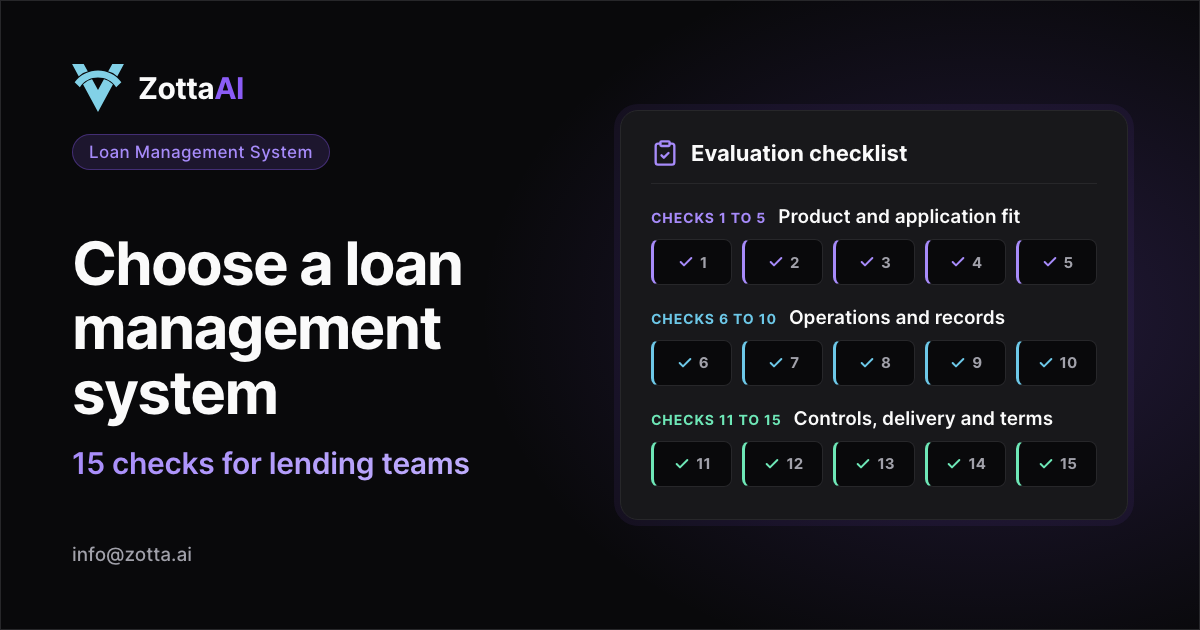
- Checks 1 to 5Product and application fitCalculations, application channels, ownership and handovers, documents, payment allocationGo to check 1
- Checks 6 to 10Operations and recordsArrears, borrower context, accounting, interfaces, reporting and data accessGo to check 6
- Checks 11 to 15Controls, delivery and termsAccess controls, AI oversight, resilience, migration, commercial scope and exitGo to check 11
Evaluation checks
15 checks to put to any vendor
Checks 1 to 5 Product and application fit
Product and calculation fit
Provide an independently calculated schedule covering your interest method, fees, rounding and repayment frequency. Compare every instalment and the total cost. Repeat with an irregular first period and a changed repayment date.
Application channels
Follow the same application through the channels you use: staff-assisted, borrower portal or merchant checkout. Check incomplete applications, duplicate submissions and the handover between borrower and staff. Identify where information must be re-entered.
Application ownership and staff handovers
Show who can view an application, add or correct information, request a missing document and move work to another team. Inspect the status history and the record of staff activity. Confirm that access permissions and handovers reflect your operating model.
Documents and agreements
Use your document types and agreement wording. Inspect extracted fields, correction steps, version history and signing evidence. Have the responsible specialists confirm that the final process meets your requirements in the intended market.
Payment allocation
Demonstrate partial, late, early and excess payments. Inspect how each amount reaches principal, interest and fees. Add a failed event, duplicate notification and reversal, then reconcile the resulting account balance.
Checks 6 to 10 Operations and records
Arrears and borrower treatment
Test missed payments, promises to pay, hardship and disputes. Review contact restrictions, escalation and staff discretion. Confirm how the system calculates delinquency and preserves the history of borrower contact and follow-up.
Borrower context and system ownership
Check whether staff can understand the relevant loans, documents and communications. For cooperatives, identify the existing systems responsible for member administration and non-loan accounts. For merchants, assess order and purchase context. Define which system owns each record and what information the lending team needs.
Accounting and reconciliation
Trace disbursement, payment, fee and reversal events into the ledger. Ask finance to verify postings, control accounts and period-close treatment. Confirm how operational totals reconcile to the accounting system you will use.
Interfaces and failure handling
List the payment, identity, accounting and other operational connections your proposed lending scope requires. Request evidence for the specific interfaces proposed. Test timeouts, retries and duplicate events, with clear ownership of reconciliation and unresolved errors.
Reporting and data access
Rebuild essential reports using an agreed sample portfolio. Reconcile loan counts, balances and arrears buckets. Confirm definitions, as-of dates, exports and whether your team can obtain usable data during normal operations and at exit.
Checks 11 to 15 Controls, delivery and terms
Access and operational controls
Test a real role matrix, including staff who should be denied access. Inspect MFA, administrator powers, separation of duties and audit records. Ask how logs are protected, retained, searched and made available to your team.
AI behaviour and oversight
For borrower summaries and collections suggestions, inspect the supporting information, staff permissions and review process. Test an incomplete or uncertain suggestion and confirm how staff can correct the record, seek help or choose a different follow-up. Agree where AI assistance belongs in the proposed service workflow.
Resilience and support
Request evidence for availability, backups, recovery tests and incident handling. Define the support hours, severity levels and response commitments your operation needs. Check whether those commitments will appear in the contract.
Migration and implementation
Inspect a sample migration of borrowers, loans, schedules and history. Agree reconciliation checks and sign-off owners before estimating rollout. Identify dependencies on your staff, source-data quality, vendors and local requirements.
Commercial scope and exit
Compare the full proposed cost: licences, transactions, implementation, interfaces, environments, support and changes. Request clear assumptions. Confirm data-export rights, exit assistance, renewal terms and responsibility for unfinished requirements.
Your shortlist
Use the evidence to build your shortlist
Classify requirements as essential, valuable or optional. Assess demonstrated evidence separately from a roadmap promise. Keep a named owner and acceptance test for every essential requirement. A useful shortlist makes the confirmed scope, evidence gaps and commercial assumptions clear.
A useful evidence record
For every essential requirement, record the scenario, expected result, observed result, evidence link, demonstrated software version and the person responsible for any gap. Use four distinct states:
- Demonstrated nowShown working with your scenario
- Configuration requiredNeeds setup or settings changes first
- Integration or development requiredNeeds a separate interface or new development
- Not demonstratedNot shown; record it as a gap
A roadmap promise is not a demonstrated capability.
Example: trace one partial payment
- Expected resultA known loan balance and an independently prepared allocation
- PaymentOne partial payment through an agreed supported channel
- Account and scheduleInspect the account and the schedule after the payment
- LedgerReconcile the resulting ledger entries
- Duplicate and reversal checksRepeat the notification, then show a reversal and a closed period
Use fictional data. Begin with a known loan balance and an independently prepared payment-allocation example. Enter one partial payment through an agreed supported channel, inspect the account and schedule, and reconcile the resulting ledger entries. Repeat the same payment notification and check that it does not create another payment. Ask the vendor to show the treatment of a reversal and a closed accounting period. Record unsupported steps as gaps. This is an evaluation script, not a claim that every vendor supports each scenario.
Keep the shortlist comparable
Run the same cases for each provider. Avoid an overall numerical score that hides a failed essential requirement. Resolve material gaps in the written implementation scope before comparing delivery estimates and total cost.
With Zotta
A focused Zotta demonstration agenda
Open a sample application, capture documents and move it through a queue. Inspect the borrower view, a payment history and an overdue-account action. For a retail-finance evaluation, bring the purchase and agreement requirements and ask which steps are available in the proposed scope. Trace a lending event to accounting and inspect permissions and audit history. Close with the interfaces, migration sample and evidence still required for your decision.
Evaluating retail finance? Read hire-purchase loan management software, or see the Zotta loan management system.
Bring your checklist to a demo
Share your essential requirements and we can shape the walkthrough around them.
Use this checklist in a Zotta demoOr email info@zotta.ai
Prepared by Zotta AI. This guide describes procurement checks, not certification, legal advice or a claim that Zotta supplies every function listed. Use fictional cases and keep real borrower data out of public demo requests.